How Money Actually Works
Loading…
Loading…
When a company refinances, the maturity is only one thing that resets. The cost of the debt, the creditor protections, the cash flows — and sometimes the balance of power in the capital structure — can change too.
The important part
Risk does not disappear.
A headline says a company has refinanced $500 million of debt and extended its maturities to 2033.
The headline tells you the maturity moved. It does not tell you what the company paid for the extra time.
Did total debt actually fall? What interest rate will the company pay now? Did the new creditors receive collateral or tighter covenants? Did the creditor base change? And what terms made investors or lenders willing to provide the replacement capital?
Those questions determine whether the refinancing materially improved the company's financial position, merely pushed a problem farther into the future, or did some of both.
A refinancing is best understood as a capital-structure reset. Old debt is repaid, amended or exchanged; replacement financing takes its place on terms available in today's market.
The maturity can be pushed out. The financing cost resets. And the creditor base, collateral or contractual protections may change.
The useful question is not simply whether a company refinanced. It is: what changed — and what did those changes cost?
Imagine a hypothetical company issued $500 million of five-year notes on October 15, 2021, with a 4% coupon and a maturity date of October 15, 2026.
For five years, the annual coupon cost is $20 million.
Then October 15, 2026 arrives and the $500 million principal itself is due.
The company can be profitable, current on every interest payment and still prefer not to use $500 million of cash to retire the notes. It may not have that much excess cash, or management may believe using it would leave the company with too little liquidity for the business.
So the company has choices: use cash, sell assets, issue equity, negotiate with existing creditors or raise replacement debt.
If it raises new financing and uses that capital to retire the maturing notes, it has refinanced the debt.
The core mental model is: refinancing replaces a near-term funding requirement with a new financing arrangement priced on today's terms.
In the clean cash-refinancing case, new lenders provide cash to the company, the company uses it to repay the existing creditors, and a new claim runs back to the new lenders — carrying interest and, eventually, principal.

In the actual refinancing transaction, the cash can move through banks, trustees, paying agents or other intermediaries, so it does not necessarily pass through the company's bank account in the simple way the diagram suggests.
But the economic result is clear: the old claim is retired or changed, and a new claim survives afterward. Old debt can be extinguished even while the company's total debt remains largely unchanged.
Take that same company as it approaches October 2026 with the full $500 million of notes coming due. Assume it refinances at maturity so we can isolate the core mechanics without introducing early-redemption premiums.
1. Management identifies the funding need. The company knows how much principal is coming due and decides how much, if any, it can repay from cash versus replace with new financing.
2. It chooses a refinancing path. Depending on the issuer and market, that might mean a new bond, a syndicated loan, private credit, an amendment-and-extension with existing lenders or a combination of sources.
3. Lenders or investors determine the terms at which the financing can clear. The company can propose a structure and target price. The transaction works only if enough capital providers are willing to fund it at acceptable terms. Their required return becomes the constraint the company has to meet.
4. The new financing and repayment of the old debt are coordinated. The company generally does not want to retire its existing financing before the replacement capital is available. Refinancings are therefore structured so the new money and the retirement of the old obligation connect operationally.
5. The new capital structure becomes live. The business may look identical the next morning. But financially, the company can now have a different maturity, financing cost, creditor group, covenant package, collateral position and future cash-interest burden.
Now suppose the company can refinance the maturing $500 million notes with $500 million of seven-year debt issued at par at a 7.5% coupon. The 7.5% is an illustrative round number, not a market quote.

The company has removed a $500 million maturity from 2026. But in this example it has not reduced the $500 million principal balance. Instead, annual cash interest rises by $17.5 million.
That $17.5 million is now cash the company cannot use for hiring, capital expenditure, acquisitions, dividends, buybacks or additional liquidity.
So the refinancing improved one part of the capital structure — near-term maturity risk — while worsening another — annual financing cost.
The cash flows are also not perfectly one-for-one. Issue discounts, underwriting or arrangement fees, accrued interest and, when debt is retired early, contractual redemption costs can mean that issuing $500 million of new face value does not create exactly $500 million of cash available to retire the old debt.
Real-world example · not our $500M case
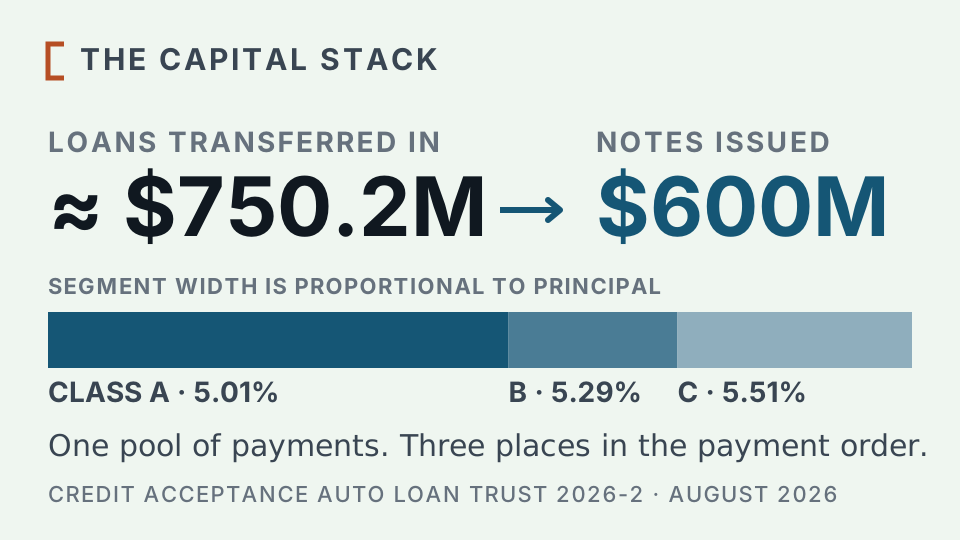
$5,290,000
T-Mobile USA · Form 424B5 · priced 7 Jan 2026 · recalculated from the filing
A refinancing is not priced by "interest rates" alone. For a fixed-rate corporate bond, a useful mental model for the required yield is Treasury benchmark + company-specific credit spread. For a floating-rate corporate loan, it is often SOFR or another benchmark + company-specific margin + fees and discount economics.
The benchmark reflects the broader price of money. The spread or margin reflects what capital providers demand for the risk of that issuer and that particular debt. Those two components can move in opposite directions.
That is why a company can sometimes refinance more cheaply even when the general level of rates remains elevated: its credit spread may have tightened enough to offset some or all of the benchmark-rate effect.
Carnival provides a clean example. In May 2025, the company issued $1.0 billion of 5.875% senior unsecured notes due 2031 and used the proceeds to redeem $993 million of 7.625% senior unsecured notes due 2026. On that slice of the capital structure, Carnival extended the maturity and lowered the coupon.
Real-world example
Carnival Corporation & plc
Form 8-K · Announced 21 May 2025 · SEC EDGAR
Establishes the closing of a $1.0 billion offering of 5.875% senior unsecured notes due 2031, and the use of proceeds to redeem $993 million of 7.625% senior unsecured notes due 2026 on 22 May 2025.
Read the filingThe point is not that benchmark rates did not matter. It is that "rates are higher" is not enough information to determine a company's refinancing cost. The issuer's own credit conditions matter too.
The simple Money Map is the foundation, not the entire universe. A company can refinance by issuing a new bond and repaying an old one; replacing one loan with another; amending and extending an existing facility; repricing a loan; moving from public bonds to private credit or vice versa; refinancing only part of a maturity and paying down the rest with cash; or exchanging old securities for new securities instead of paying every creditor cash.
Those structures can produce very different outcomes even when the headline uses the same word: refinancing.
There is also a separate complication when a company wants to retire debt before maturity. The governing contract determines whether early redemption is allowed and what price the company must pay. Depending on the instrument, leaving early can cost more than face value. That is why our $500 million base example refinances at maturity: it keeps the core machine visible without mixing in a separate set of call mechanics.
A refinancing does not make risk disappear. It reallocates it.
Before the transaction, existing creditors own the claim and the company faces a near-term maturity. After a clean replacement refinancing, old creditors receive their repayment and exit; new creditors own the replacement claim; the company has more time before principal is due; shareholders may have less residual cash flow if financing costs rise; and the company may have accepted new covenants, collateral requirements or other constraints.
Risk has moved through time because the maturity moved. It can also move across the capital structure. Unsecured creditors may be replaced by secured creditors. New lenders may receive stronger contractual protections. Assets that were previously unencumbered may become collateral.
So "maturity extended" tells you only part of the transaction. You also need to know what the company gave up to get the extension.
Now change the assumptions in the $500 million example. What if investors will lend the money only at 11%? Annual cash interest would rise to $55 million — $35 million more than the company had been paying. Maybe the company can absorb that. Maybe it cannot.
What if investors will provide only $400 million unless the company pledges collateral? The company now has a $100 million funding gap and a choice: find another capital source, use cash, sell assets, issue equity, negotiate with existing creditors or accept stronger creditor protections.
Or the public bond market may simply be unavailable to that issuer, pushing it toward private credit, a bank amendment, an exchange offer or a broader restructuring.
This is why refinancing risk is not merely an interest-rate problem. The danger is that acceptable replacement capital may not be available when the maturity arrives. A company can have a viable operating business and still face a serious financing problem if the capital markets will not fund the balance sheet on terms it can sustain.
A "successful refinancing" can improve the company's position and still make parts of the capital structure worse.

Medical Properties Trust is a useful stress case. In August 2026, MPT closed transactions involving $2.4 billion of new 9.25% senior secured notes due 2032. Cash proceeds were designated to redeem its 2026 notes in full and part of its 2027 notes, while roughly $1.5 billion of unsecured notes due from 2027 through 2031 were separately exchanged into the new structure. The transactions also reduced total principal debt by approximately $123 million.
Real-world stress case
Medical Properties Trust, Inc.
Form 8-K, Items 1.01, 2.03, 9.01 · Filed 10 August 2026 · SEC EDGAR
Establishes the closing of $2.4 billion of 9.25% senior secured notes due 15 February 2032, the redemption of the 2026 notes in full and part of the 2027 notes, a concurrent private exchange of roughly $1.5 billion of 2027–2031 unsecured notes, and an expected reduction of total principal debt of approximately $123 million.
Read the filingThat is not the simple cash refinancing in our hypothetical; it is a hybrid refinancing-and-exchange transaction. But the trade is visible. MPT reduced near-term maturity pressure and modestly reduced principal. In exchange, the new securities carried a 9.25% coupon and stronger secured creditor claims.
The refinancing can therefore make the company less exposed to an immediate maturity while increasing its cash-interest burden or giving creditors a stronger position. That is why "maturity extended" and "balance sheet improved" are not synonyms.
The better question is: what risk disappeared — and what risk replaced it?
Refinancing is one of the mechanisms through which financial-market conditions eventually reach corporate cash flow and the real economy.
A company with long-dated fixed-rate debt does not reprice its entire balance sheet every time interest rates move. It can continue paying yesterday's coupon until the debt matures or is refinanced. The reset can arrive years later.
Research on corporate debt has shown how this rollover mechanism delays the transmission of higher borrowing costs: as fixed-rate debt matures, companies have to replace it at the financing conditions available then.
That can affect far more than the finance department. Higher cash-interest expense can mean less money for hiring, investment, acquisitions, shareholder distributions or liquidity. A difficult refinancing can force asset sales, equity issuance or other balance-sheet decisions before the underlying operating business has visibly deteriorated.
A maturity schedule is therefore not just an accounting footnote. It is a calendar showing when yesterday's financing decisions will have to meet tomorrow's market.
When a headline says a company has refinanced its debt, ask:
Once you can answer those questions, a refinancing headline stops being a status update. It becomes a map of who supplied the money, what the company paid for time and where the risk moved.
Related machinery: How a Company Actually Issues a Bond · How a Syndicated Loan Actually Gets Made and Distributed · debt exchanges and liability management · credit spreads · collateral and creditor priority.
The $500 million company in this explanation is hypothetical, and the 7.5% replacement coupon is an illustrative round number rather than a market quote. They exist to make the mechanism legible; no figure derived from them describes a real transaction. Carnival, T-Mobile and Medical Properties Trust are real transactions read from their own SEC filings, and their figures are never blended into the hypothetical arithmetic. Medical Properties Trust is a hybrid refinancing-and-exchange, not the base case. Where this explanation describes how refinancing carries market conditions into corporate cash flow, it rests on Federal Reserve research rather than on any single company's experience.