How Money Actually Works
Loading…
Securitization is not a magic trick that turns risky loans into safe bonds. It is a legal and cash-flow machine that moves assets into a financing vehicle, raises money from investors and turns one stream of payments into claims with different priorities.
A lender makes hundreds or thousands of loans. Those borrowers will repay over months or years.
How does that pile of future payments become a bond that an investor can buy today?
The usual answer is that the loans are bundled together and sold as securities.
That is accurate in the same way that saying a company “issued a bond” is accurate. It names the outcome and skips the machine.
The machine matters because several different things happen at once. The company that originated the loans can stop being the legal owner of them. A separate vehicle can borrow against those loans. Investors can own different claims on the same pool of cash flows. And a contractual waterfall can determine which claim gets paid before another when cash comes in.
The borrowers do not suddenly become safer because the structure exists.
What changes is who funds the loans, who legally owns them and who stands where in the payment line.
The important part
Securitization does not turn bad loans into good loans.
Start with a loan. A borrower receives money today and promises to make payments later. To the lender, that promise is an asset: a stream of future cash flows.
Now multiply that by thousands of loans.
Instead of keeping the entire pool until maturity, the lender can transfer it into a financing vehicle that issues securities to investors. Investors provide cash; in return, they receive contractual claims on the money generated by the pool. The financing proceeds can move back through the structure to the original lender.
The same borrower payments can now support several securities — but those securities do not have equal rights. One class can sit ahead of another, buffers can protect more senior claims, and whatever remains after the contractual obligations are satisfied can flow to a residual holder.
So securitization does not create more borrower cash.
It creates a hierarchy of claims on the cash that already exists.
A real auto-loan securitization makes the structure visible.
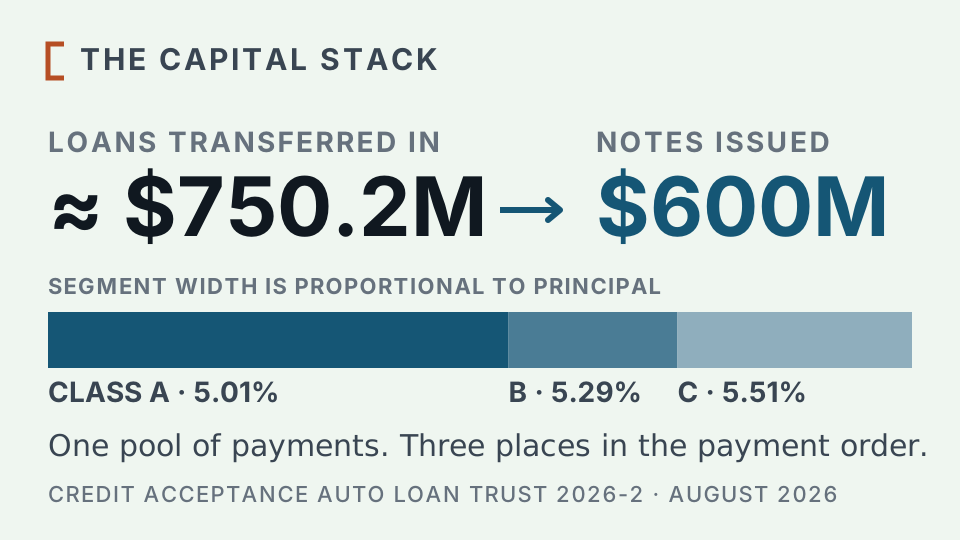
In August 2026, Credit Acceptance transferred approximately $750.2 million of consumer loans through a wholly owned funding entity into Credit Acceptance Auto Loan Trust 2026-2.
The trust issued $600 million of asset-backed notes to investors.
That creates two different flows at the beginning of the transaction.
First, the assets move: Credit Acceptance → Funding 2026-2 → securitization trust.
Second, the money moves in the opposite direction: note investors → securitization trust → funding entity → Credit Acceptance.
The sale-and-contribution documents make that second leg explicit: Credit Acceptance's consideration includes the net cash proceeds the funding entity receives when the assets are transferred onward to the trust.

Then the direction changes again.
Borrowers keep making payments on the underlying loans. Credit Acceptance remains the servicer. Collections enter the structure, servicing and other contractual claims are paid, and the remaining cash moves through the waterfall to investors according to the deal documents.
That is the basic money map: Investors fund the vehicle. The vehicle funds the asset transfer. Borrowers replenish the vehicle with cash over time. The waterfall determines who receives that cash next.
The borrower still owes the underlying loan.
The originator or seller made or acquired the loans and can transfer them into the securitization for financing proceeds.
The funding entity and issuer move the assets through the legal chain and place them inside the vehicle that issues the securities.
The servicer collects and administers borrower payments; the originator can remain the servicer even after transferring the pool.
The noteholders provide financing and own ranked claims on the cash flows, while the residual holder receives what remains after the senior contractual claims are satisfied.
The key distinction is that origination, ownership, servicing, funding and risk-bearing do not have to sit with the same entity.
The Credit Acceptance transaction is useful because the documents show each layer separately.
1. Loans move out of the originator.
Credit Acceptance transfers the loans and related rights to Funding 2026-2, which then transfers them into the trust. The documents are designed to establish a sale or absolute transfer at the relevant legal level, while the entities can still remain consolidated for GAAP reporting.
That distinction matters. Legal ownership, accounting presentation and economic exposure are related, but they are not identical concepts.
2. Investors fund the trust.
The trust issues three classes of notes totaling $600 million: Class A of $319.88 million at 5.01%, Class B of $117.30 million at 5.29%, and Class C of $162.82 million at 5.51%.
The note documents explicitly subordinate Class B to Class A and Class C to both A and B.
So even though all three classes ultimately depend on the same pool of underlying loans, they do not stand in the same contractual position.

3. The pool can revolve before it amortizes.
For the first 24 months, the structure has a revolving period. Subject to the transaction rules, principal collections can help fund additional eligible loans rather than simply paying the notes down immediately.
After the revolving period ends, the machine changes from replenishing the asset pool to paying the financing down.
4. The cash hits a waterfall.
The sale-and-servicing agreement specifies the order in which available funds move through the structure.
Servicing, trustee and related transaction costs sit ahead of the investor payment stack. Note interest then moves through the classes in contractual order. The reserve account can be replenished. Once the deal is amortizing, principal is paid Class A first, then Class B, then Class C. Only after the contractual note claims are satisfied does remaining cash flow to the certificateholder.
The document that sets the order
Credit Acceptance Auto Loan Trust 2026-2 / SEC
Credit Acceptance 2026-2 ABS — Sale and Servicing Agreement · Filed 20 August 2026
Sections 5.08 to 5.10 set the ordinary-course order of payments and define the Reserve Account Requirement. The order below is read from this agreement and governs this transaction only.
Read the filing
That is what a waterfall actually is.
It is not a metaphor for complexity. It is a set of instructions telling the structure where the next dollar goes.
There are really two separate money stories in a securitization.
The first happens at issuance.
Investors send cash to the issuing vehicle. The vehicle issues securities. The financing proceeds move back through the legal chain toward the seller. In exchange, the loan pool sits inside the securitization structure as the asset supporting the notes.
The second happens after issuance.
Borrowers send cash into the loan pool over time. The servicer collects it. Contractual fees and expenses come out. The remaining money is allocated according to the waterfall.
This distinction is important because securitization lets the originator convert a long stream of future borrower payments into financing today.
The originator does not have to wait years for every loan in the pool to repay before recycling that capital.
But investors are not buying the originator's promise to repay them in the ordinary corporate sense. They are buying claims structured around the assets and cash flows inside the securitization vehicle, subject to the transaction's recourse and contractual protections.
In the Credit Acceptance transaction, the trust debt is secured by trust assets and is non-recourse to Credit Acceptance except for limited customary obligations.
That moves an important part of the financing risk away from the originator's general corporate balance sheet and into the asset-backed structure.
It does not mean the originator has no remaining exposure. Credit Acceptance still services the loans, the agreements preserve certain repurchase and indemnification obligations, and the broader corporate group still has economic relationships with the structure.
Non-recourse does not mean no connection.
The three note classes are claims on the same transaction, but their coupons rise as the claim moves down the contractual stack: 5.01% → 5.29% → 5.51%.
That is the economic intuition behind tranching.
A more senior investor receives a claim with more contractual protection from the layers beneath it. A more subordinated investor stands closer to the point where a cash shortfall can become its problem.
The lower-ranking claim therefore generally needs more compensation.
That does not mean seniority alone determines a bond's coupon. Market rates, expected maturity, liquidity, collateral performance, structure and investor demand all matter.
But inside one transaction, the pricing ladder makes the basic trade visible: more protection generally means less yield; more exposure to shortfall generally requires more yield.
Securitization does not remove the underlying credit risk. It redistributes it.
The borrowers still have to make their payments. If they do not, the pool receives less cash.
The servicer carries operational responsibilities for collecting and administering that cash.
The residual holder receives only what is left after more senior contractual claims are satisfied.
Within the note stack, Class C is subordinated to Classes A and B. Class B is subordinated to Class A. Class A sits at the top of the note payment hierarchy.
The structure also contains a reserve account. In this transaction, the reserve requirement is tied to 2% of the initial aggregate note balance, subject to the remaining aggregate note balance as the deal pays down.
That reserve can provide an additional buffer, but it still does not create borrower payments that never arrived.
Collateral transferred, against notes issued
~$750.2M against $600M
Credit Acceptance 2026-2 Form 8-K
This is the point that gets lost when securitization is described as financial alchemy.
The structure can reorder risk. It can place buffers beneath senior investors. It can redirect cash according to a contract. It can make one pool financeable for investors with different risk appetites.
It cannot make the underlying borrowers pay more than they actually pay.
The cleanest way to understand a waterfall is to imagine there is not enough water.
FAT Brands provided a real example from a different kind of securitization: whole-business securitization rather than auto ABS.
In a 2025 filing, the company disclosed events of default across several securitization issuers, including a situation where the trustee could not make payments due to noteholders because the collection accounts did not contain enough money.
The breakdown, at its actual scope
FAT Brands Inc. / SEC
FAT Brands whole-business securitization defaults — Form 8-K · Filed 2025
Events of default across five whole-business securitization issuers, including the trustee's inability to make payments due to noteholders because insufficient amounts had been deposited in the relevant collection accounts. Used here for that mechanism only — not as evidence about whole-business securitization as a category, and not as a diagnosis of what operationally caused the shortfall.
Read the filingThe point is not that every whole-business securitization behaves that way. It does not.
The point is mechanical.
A waterfall can determine who has the first claim on $100 that arrived.
It cannot turn $70 of actual cash into $100.
When the underlying cash flow is insufficient, the capital structure tells you where the shortage lands and in what order. It does not eliminate the shortage.
The real transformation in securitization is not the bundling of loans.
It is the separation of origination, ownership, servicing, funding and risk-bearing.
The company whose name the borrower recognizes may have made the loan and may still collect the payment. A special-purpose entity may own the asset. A trust may issue the securities. Different investors may fund the same pool while occupying completely different positions in the payment hierarchy.
That is the machine hidden inside the phrase “the loans were bundled into bonds.”
Securitization builds a capital structure around a pool of cash flows. It changes who funds the assets, who owns the claims and who takes the shortage first.
It does not change the amount of cash the underlying borrowers actually produce.
Once you understand that, securitization stories become much easier to read.
When you see mortgage-backed securities, auto ABS, credit-card securitizations, equipment receivables, whole-business securitizations or eventually a CLO, ask five questions:
Those questions cut through most of the jargon.
Securitization does not turn bad loans into good loans.
It turns one pool of future cash flows into a stack of claims with different rights to the same money — and different positions when there is not enough of it.
The next mechanism is the other side of the credit machine: how bank capital limits how much a bank can lend.
A securitization can move assets and risk away from one balance sheet. Bank-capital rules help explain why a bank might want to do that in the first place.
This explanation rests on five primary documents filed with the Securities and Exchange Commission, each used only for the mechanism it documents. The transaction chain, the amounts, the servicing fee, dealer holdback and the two-phase revolving and amortization structure come from **Credit Acceptance's Form 8-K** announcing the financing. The three note classes, their sizes and rates, and the contractual subordination of Class B to Class A and of Class C to Classes A and B come from the **indenture and the note forms**. The ordinary-course order of payments and the Reserve Account Requirement come from the **Sale and Servicing Agreement**. The first leg of the asset transfer, and the definition of what Credit Acceptance received in return, come from the **Sale and Contribution Agreement**. The breakdown example comes from **FAT Brands' Form 8-K**. What this story refuses to say is as deliberate as what it says. The roughly $150.2 million by which transferred collateral exceeds issued notes is **not** described as overcollateralization: no document-defined level, test, trigger or cure is established, and the two figures may be measured on different bases. The waterfall shown is **this transaction's**, read from its own Sale and Servicing Agreement, and is not offered as a universal template. Dealer holdback is specific to Credit Acceptance's dealer-assignment model rather than a general feature of securitization, and because its exact rank in the contractual priority is not established it is named but not placed in the order. The FAT Brands filing is used for one mechanical proposition only — that a trustee could not pay noteholders because the collection accounts lacked sufficient funds — and not as evidence about whole-business securitization as a category, nor as a diagnosis of the underlying business. Two distinctions are preserved throughout. Legal transfer, GAAP consolidation and retained economic exposure are related but not identical: the first leg is documented as a sale or absolute transfer on Credit Acceptance's non-consolidated books while the entities remain consolidated for GAAP. And non-recourse is not the same as no connection: the carve-out for limited customary obligations, the retained servicing, the dealer holdback and any residual position are all economics that stay with the originator.