How Money Actually Works
Loading…
A bank can have deposits, cash and willing borrowers and still decide it cannot — or should not — make the next loan. The reason is that funding the loan and having enough capital to support the enlarged balance sheet are two different things.
If a bank has the money, why can't it just make the loan?
Most people picture bank lending as a warehouse problem. The bank gathers deposits, keeps some in reserve, and hands the rest to borrowers. On that picture, a bank with plenty of deposits and a creditworthy customer has no reason to say no.
That is not how it works. A bank does not go and find a deposit before it can write a loan. It writes the loan, and the borrower ends up holding a balance the bank owes. The balance sheet gets bigger on both sides at once. What the bank must then do is fund and manage that larger balance sheet — hold liquidity, keep the funding stable, replace it if it leaves.
That is a real constraint. It is not the one this story is about.
Because a bank can have the funding for the next loan and still decide that the loan uses too much capital.
Those are not the same thing.
The important part
A bank does not have to run out of money to run out of room.
Funding answers one question:
Can the bank hold on to the money that now sits on the other side of the loan — and replace it if it leaves?
Capital answers another:
How much loss-absorbing support sits behind the bank's assets if things go wrong?
A deposit is money the bank owes someone else. Equity capital is different. It is the layer that can absorb losses before depositors and many other creditors take them.
It is also the simplest number on the balance sheet: what is left when you subtract everything the bank owes from everything the bank owns. It is the owners' stake — money shareholders put in, plus profits the bank kept instead of paying out.
So a bank's ability to make another loan is not settled by whether the funding is there.
It also depends on what that extra $100 does to the bank's balance sheet, its risk-weighted assets and its capital ratios.
The crucial point is this:
A bank does not have to run out of money to run out of room.
Take a deliberately simplified bank.
It has $1,000 of assets, $900 of liabilities and $100 of common equity capital.
That $100 is not a separate pot. It is the $1,000 minus the $900.
Now suppose those assets produce $800 of risk-weighted assets, or RWA.
With $100 of common equity tier 1 capital — CET1, the highest-quality loss-absorbing layer — against $800 of RWA, the bank's CET1 ratio is $100 ÷ $800 = 12.5%.
It is worth knowing what the real thresholds look like, because the 12% target used later in this story is invented for the example. Under the current U.S. capital rule the minimum CET1 ratio is 4.5%. Large banks are not managed anywhere near it: they also carry a stress capital buffer of at least 2.5%, and the largest carry a GSIB surcharge on top of that. Those buffers sit above the minimum, and a bank that falls into them faces restrictions on dividends and buybacks rather than a prohibition on lending — which is one reason banks manage to a self-imposed target well clear of both.
That ratio matters because bank capital rules do not generally treat every dollar of assets as if it carried the same risk.
The denominator is not simply total assets. For risk-based capital ratios, it is risk-weighted assets.
A corporate borrower comes along and wants $100.
The bank likes the borrower. The loan is properly underwritten. So the bank makes it.
Two things appear at once. A $100 loan on the asset side. And $100 the bank owes on the liability side — the borrower's money, sitting in an account, available to be spent or moved. The bank's job from here is to fund and manage that larger balance sheet, not to have found the money first.
The balance sheet becomes $1,100 of assets, $1,000 of liabilities and the same $100 of common equity capital.
Nothing has gone wrong. No cash shortage, no deposit shortage, no funding gap.
But there is another calculation.
Under the current U.S. standardized capital approach, a corporate exposure receives a 100% risk weight. The approach does not grade that weight by the borrower's credit rating — a strong corporate borrower and a weak one consume the same risk-weighted balance sheet, which is a large part of why the constraint bites. A corporate loan that falls 90 days or more past due moves higher still, to 150%.
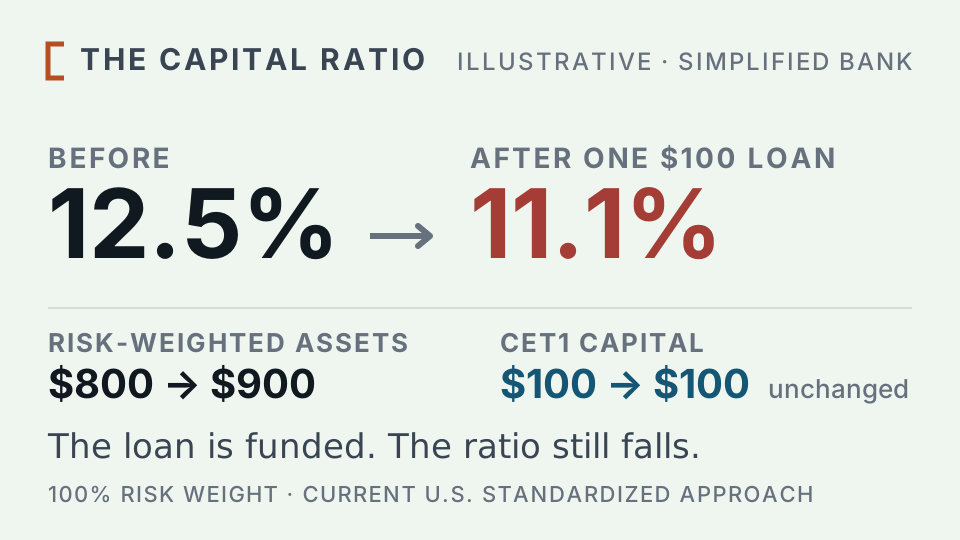
So the new $100 corporate loan adds $100 of RWA. RWA rises from $800 to $900.
The bank still has the same $100 of CET1 capital. Its CET1 ratio falls to $100 ÷ $900 = 11.1%.
The bank's CET1 ratio, before and after one $100 loan
12.5% → 11.1%
Illustrative simplified bank; minimum from 12 CFR 217.10(a)(1)(i)
The bank never had to go and find the money.
What it used up was some of its capital-ratio capacity.
Capital is not a pile of cash sitting in a separate account next to the loan.
When someone says a bank needs more capital to support more lending, that does not mean the bank takes $10 of cash and locks it away every time it lends $100.
Capital is part of how the bank is funded in the first place: the equity, and certain instruments that behave like it, standing behind the assets.
So there are two separate questions happening at once:
Can the bank fund the asset?
And: Can the bank support the asset without pushing its capital position below the level regulators, markets or management require?
A bank can answer yes to the first question and no to the second.
Not every $100 loan consumes the same amount of risk-weighted balance sheet.
The corporate loan above took a 100% risk weight. A first-lien residential mortgage takes 50% — but only if it meets the conditions the rule actually sets out: the property is owner-occupied or rented, the loan was made under prudent underwriting standards including loan-to-value, it is not 90 days or more past due, and it has not been restructured or modified.
Miss any one of those and the same mortgage takes 100% instead. So does any junior-lien mortgage.
That last point is the one worth holding on to. A performing mortgage that falls 90 days past due doubles the risk weight it carries, and the bank has not originated anything new. The category did not change. The condition did.

The rule that assigns the weights
Board of Governors of the Federal Reserve System
Regulatory capital rule, 12 CFR 217.32(f) and (g) · Last substantively amended 17 September 2020
Paragraph (f) assigns a 100% risk weight to corporate exposures. Paragraph (g)(1) assigns 50% to a first-lien residential mortgage meeting four stated conditions, and (g)(2) assigns 100% where any condition fails and to junior liens. These provisions bind Board-regulated institutions; the OCC and FDIC maintain parallel rules.
Read the filingSo two assets with the same face amount can add very different amounts to the denominator of a risk-based capital ratio.
That does not mean one asset is universally “safe” and the other is universally “risky.” It means the framework assigns capital treatment by category and by condition.
These are the weights under the rule in force today. In March 2026 U.S. regulators proposed revising the standardized approach, including the treatment of both corporate exposures and residential mortgages. Those revisions are proposals, not law, and the numbers above are the ones that currently apply.
Go back to the bank. It is now carrying $900 of RWA against the same $100 of CET1 — a ratio of 11.1%, down from 12.5%.
Suppose management wants to operate at an illustrative 12% CET1 target.
That is not a regulatory minimum — the minimum is 4.5%, and the bank is still comfortably above it. The 12% is simply a clean management assumption for this example.
At $900 of RWA, a 12% target implies $900 × 12% = $108 of CET1 capital.
The bank has $100.
So relative to that illustrative target, the new loan has created an $8 capital gap.
The bank did not need $8 of cash to make the loan. The loan was already funded. The $8 is the additional common-equity support the bank would need to restore the same target ratio after expanding the balance sheet.
That is a completely different constraint.

Capital is valuable because shareholders expect a return on it.
So banks do not evaluate a proposed loan only by asking whether the interest rate covers the cost of deposits. The economics also have to cover expected credit losses, operating costs, and the opportunity cost of the capital and balance-sheet capacity committed to the transaction.
A 1998 Federal Reserve System task force report, based on discussions with twelve large banking organizations, documented exactly this machinery: banks allocating economic capital to individual transactions and using risk-adjusted return on capital — RAROC — in loan pricing. In that framework a bank can calculate the rate a loan needs to earn for the expected return on the capital allocated to it to clear the bank's hurdle rate, the minimum return a transaction has to produce to be worth doing.
Where the pricing link is documented
Federal Reserve System Task Force on Internal Credit Risk Models
Credit Risk Models at Major U.S. Banking Institutions: Current State of the Art · May 1998
A survey of twelve large banking organizations documenting the allocation of economic capital to individual transactions and the use of RAROC-style hurdle rates in loan pricing. It is a point-in-time study of then-current practice, and internal economic capital is not the regulatory capital calculation.
Read the filingInternal economic capital and regulatory capital are not the same measure. A bank's RAROC model is a management tool, not the regulatory calculation. But the intuition is the same: balance-sheet capacity is scarce, so a loan has to earn enough to justify using it.
That is one reason a bank may like a borrower and still quote a spread — the margin it charges over its own cost of money — that the borrower thinks is too high.
It also cuts the other way. Competition and relationship economics are real: a bank will sometimes price below what the model alone would demand, to win a client or protect one it already has. Capital consumption is one input into the price, not the whole of it.
If a loan does not produce enough return for the amount of capital it consumes, the bank has choices.
It can charge more. A higher spread or fee can improve the return on the capital allocated to the loan.
It can hold less — originate the loan but syndicate part of it to other lenders, reducing the exposure it keeps.
It can securitize or transfer risk. Depending on the asset, structure and rules, the bank may move exposures or risk to other investors rather than hold the full position.
It can raise or retain more capital. More common equity means more capacity to support assets. But that equity carries a shareholder return requirement, which is why banks manage capital as a scarce resource rather than free balance-sheet space.
It can choose a different asset. Two opportunities with similar headline yields can produce very different returns once funding, credit risk and capital consumption are counted.
Or it can simply decline the loan — not because it lacks cash, but because the loan does not clear the bank's balance-sheet economics.
The bank is not deciding whether your loan is good.
It is deciding whether your loan is the best use of a balance sheet that has room for a limited number of loans.
Those are different questions, and only the second one explains why a sound borrower gets a price they think is wrong, or no offer at all.
Liquidity is about meeting cash obligations and funding assets. Capital is about absorbing losses and supporting the size and risk of the balance sheet. Profitability decides whether using that capacity here, rather than somewhere else, is worth it.
Those three questions overlap. They are not interchangeable.
This mechanism explains several things that otherwise look contradictory.
A bank can report strong liquidity in the same quarter it tightens credit, and both statements are true.
A business can have the same revenue, the same collateral and the same credit file as last year and still be quoted a wider spread.
A bank can originate a loan and syndicate or securitize it within weeks, not because the loan was bad, but because keeping it was expensive.
And two banks looking at the same borrower can offer very different terms, because they have different capital positions, risk appetites, funding costs, portfolio concentrations and return hurdles.
Capital requirements are not the only constraint on lending. Underwriting standards, liquidity, deposit stability, concentration limits, market conditions and loan demand all matter too.
But capital is one of the reasons “the bank has the money” is not the end of the analysis.
The loan needs funding. The enlarged balance sheet needs capital. And the capital has to earn a return.
That is why banks can run out of lending capacity long before they run out of money.
The next layer is collateral: why giving a lender a claim on an asset can change pricing, recoveries and credit capacity — without eliminating the underlying risk.
This explanation rests on the text of the capital rule itself, on Federal Reserve supervisory and explanatory material, and on two pieces of Federal Reserve staff research — each used only for the thing it actually establishes. The ratios come from the rule. **12 CFR 217.10** supplies the current minimums; **12 CFR 217.32** supplies both risk weights the story teaches, including the four conditions a first-lien residential mortgage must meet to take 50% and the 100% that applies when any of them fails. The **2026 large bank capital requirements** disclosure is why the story does not leave 4.5% standing as though it were a target: large banks stack a stress capital buffer and, where applicable, a GSIB surcharge on top of it. The **liquidity-versus-capital FAQ** supplies the distinction the whole piece turns on. Two mechanisms come from staff research. The opening — that a bank credits the borrower, so the loan and the deposit appear together — follows Federal Reserve staff work on deposit growth, and is the reason this story does not describe a bank gathering deposits before it lends. The bridge from scarce capital to loan pricing follows a **1998** Federal Reserve System task force survey of twelve large banking organizations. That study is dated here deliberately: it is a point-in-time picture of practice, and internal economic capital has never been the regulatory capital calculation. What this story refuses to say is as deliberate as what it says. The **12% CET1 target is invented** for the worked example and is labelled as such everywhere it appears; the regulatory minimum is 4.5%. The **$8** is not cash needed to fund the loan — the loan is already funded — but the additional loss-absorbing capital that would restore the same target ratio on a larger balance sheet. Capital is not cash held beside a loan. A risk weight is a regulatory classification, not a forecast of what a loan will lose. And the risk weights shown are examples under one framework: they bind Board-regulated institutions, the OCC and FDIC maintain parallel provisions, and exact treatment varies by exposure. One freshness point matters more than the rest. On 19 March 2026 U.S. regulators proposed revising the standardized approach, and Docket R-1888 would change the very weights this story teaches. Those proposals were published in the Federal Register on 27 March 2026 and their comment periods closed on 18 June 2026. As of 15 September 2026 they remain proposals: no final rule, no effective date, and 12 CFR 217.32 unchanged since 17 September 2020. Everything above describes the rule in force on that date.