Treasury Is Buying Back More Long-Dated Bonds. Here's What That Can — and Cannot — Do to Long-Term Rates.
The government is expanding an existing bond-buyback programme. It may improve liquidity and reduce some long-duration pressure — but it is not QE, and Treasury still cannot set the 30-year yield.
By Ithran Olivacce · Founder & Editor-in-Chief Published · Approx. 8 min read
What Happened
The number sounds enormous and the mechanism sounds familiar. Neither impression survives contact with what Treasury actually announced.
On 19 August 2026, the Treasury said it would at least double the maximum size of its liquidity support buyback operations in two specific slices of the bond market: nominal Treasury securities maturing in 10 to 20 years, and those maturing in 20 to 30 years. The cap per operation rises from $2 billion to at least $4 billion, effective 9 September and running through 4 November 2026.
Treasury did not start buying bonds. It was already running these operations, in these same sectors, at up to $2 billion each. What changed is the size of the bucket, not the existence of the programme. That distinction matters more than it sounds.
Why the Long End Matters
Treasury picked a narrow target: the long end of its own curve. To understand why that choice is interesting, you need to know what makes a 30-year bond different from a 2-year note.
The difference is duration — the sensitivity of a bond's price to a change in interest rates. A short bill has very little interest-rate sensitivity because it matures quickly. A 30-year bond has decades of cash flows still to come, and the present value of those payments changes far more when the yield the market demands moves. Whoever owns that bond is carrying that risk.
Because of that long horizon, the 30-year yield is less a bet on this month's inflation print than on the whole distribution of possibilities across thirty years: inflation over decades, the path of short-term rates, and how much extra compensation investors want simply for locking money up that long. That last piece — the term premium — is the part that moves when investors get nervous about the supply of long bonds or the durability of the fiscal picture. It is also the part that a central bank does not directly set.
That is why the long end has its own supply-and-demand problem. The pool of buyers willing to hold thirty years of duration is smaller and more price-sensitive than the pool that will hold a three-month bill. When that pool thins, yields at the long end can rise even while short rates and current data point the other way — which is precisely the divergence we examined in our previous piece on why the 30-year stayed high while the economy softened.
And the long end is not an abstraction. Long-term Treasury yields are the reference rate underneath a 30-year mortgage, underneath long-dated corporate borrowing, and underneath the discount rate that shapes what long-duration assets are worth. They also set what the federal government pays to borrow at the long end of its own debt stack. When the 30-year moves, those things move with it.
In Lay Terms
Treasury is offering to buy back some of its older, less actively traded long bonds from the market, and it is now willing to buy up to twice as much per session as before. It pays cash for them, and the bonds it buys are retired.
Think of it less as the government paying down debt and more as the government tidying a crowded shelf. The bonds being repurchased are mostly "off-the-run" — older issues that have been superseded by newer ones and that trade thinly as a result. They still exist, someone still owns them, but they are harder to sell quickly at a fair price. Treasury is offering to be a reliable buyer of exactly those.
Follow the Money
The operation is a reverse auction, and the mechanics are worth walking through slowly.
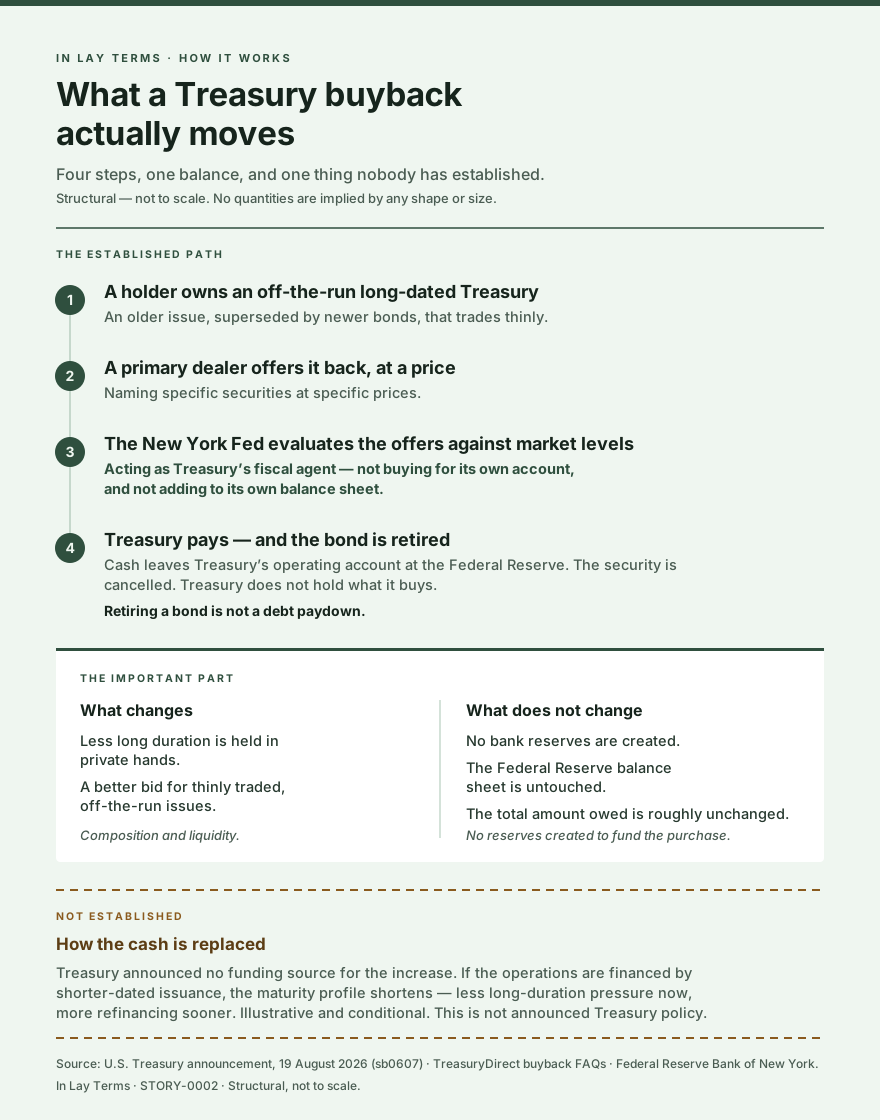
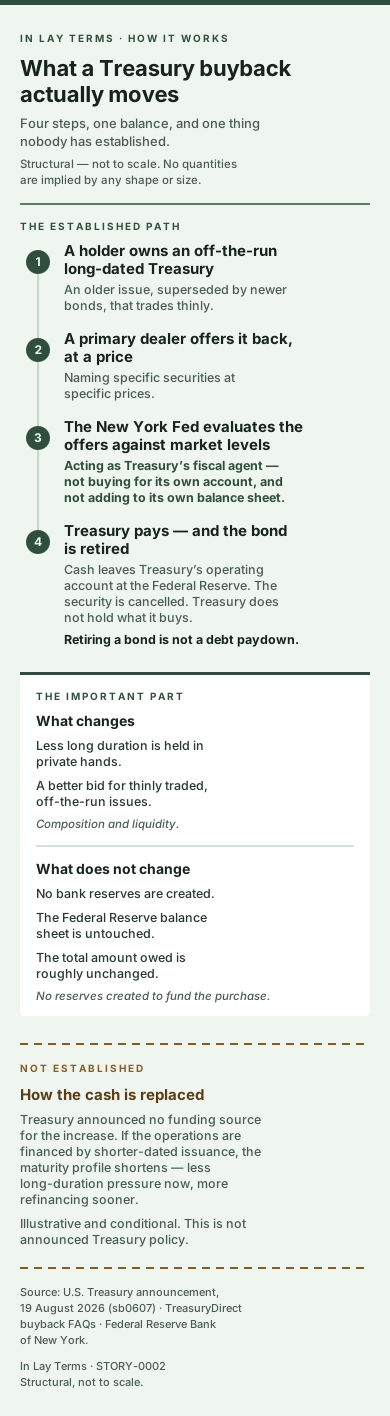
Treasury publishes the list of eligible securities it will consider. Primary dealers — the banks obliged to participate in Treasury auctions — submit offers, naming specific bonds at specific prices. The Federal Reserve Bank of New York, acting as Treasury's fiscal agent rather than on its own account, evaluates those offers against where the bonds are actually trading. Treasury then accepts the offers it judges good value, up to the maximum size of the operation, and pays for them. Settlement is typically one business day later. The repurchased bond is retired.
Two details in that sequence do a lot of work.
First, Treasury accepts offers on relative value up to a cap. It is not standing in the market bidding whatever it takes. It is a price-taker at the margin, choosing among what is offered.
Second, the New York Fed is executing on Treasury's behalf. This is a fiscal agency function, not a monetary operation, and the distinction is the whole reason the QE comparison fails.
Where does the cash come from? Here it is worth being precise, because less is established than the question suggests.
What is established: the settlement cash comes out of Treasury's operating account at the Federal Reserve, and Treasury must fund its overall cash needs through its existing cash and debt-management framework — the same machinery of auctions and bills it always uses.
What is not established: the specific incremental financing Treasury intends to use for these larger operations. The 19 August announcement names no funding source at all. Separately, reporting on 24 August attributed to unnamed sources suggested Treasury could draw on its roughly $1 trillion cash balance. That is attributed reporting, not announced or committed Treasury policy, and it should not be read as a decision that has been made.
This matters because the economic interpretation depends on it. If larger buybacks are ultimately financed by issuing more short-dated debt, the operation functions as a maturity swap — long duration comes out of the market, shorter duration goes in, and the total amount owed is roughly unchanged. If instead they are funded by running down an existing cash balance, the near-term composition effect is different. Treasury has not said which, and we are not going to pretend otherwise.
Structural diagram — not to scale; no quantities are implied by any shape or size. Retiring a bond is not a debt paydown. The unresolved funding path is shown as NOT ESTABLISHED — Treasury announced no funding source.
Why This Is Not QE
When the Federal Reserve buys Treasury bonds under quantitative easing, it pays with bank reserves that it creates, and it keeps the bonds on its own balance sheet. Both halves matter: new reserves enter the banking system, and the securities are held rather than extinguished.
Treasury can do neither. It has no authority to create money or bank reserves. It can spend only cash it already holds or obtains through the fiscal and debt-management system — taxation, borrowing, or an existing cash balance. And it does not hold what it buys; the bond is cancelled.
So the balance-sheet consequences are almost opposite. QE expands the central bank's balance sheet and adds reserves. Unlike QE, a Treasury buyback does not expand the Federal Reserve's balance sheet or create bank reserves to fund the purchase. It primarily changes the composition of Treasury liabilities held by the public, with the exact near-term balance-sheet effects depending on how Treasury finances the operation.
What This Can — and Cannot — Do to the 30-Year
Now the question a careful reader actually wants answered: can this push long-term yields down?
The channels through which it might are real. Buying off-the-run long bonds gives holders a dependable exit, which can tighten the gap between what those bonds are worth and what you can actually sell them for. Retiring long bonds removes some long duration from private hands, and if the pool of buyers for duration is the binding constraint, less of it outstanding is marginally helpful. Sellers receive cash, and some will redeploy it — possibly into other Treasuries, possibly not. And announcements carry information: a market that reads this as the Treasury paying attention to the long end may reprice on the signal well before any bond is actually bought.
One plausible explanation for why the initial move was larger than the announced flow alone might suggest is the signalling channel. On the day of the announcement the 10-year yield fell about 6 basis points and the 30-year about 9. Those are reported market levels, and the sequence is correlation rather than demonstrated causation — several other forces were acting in the same window. Much of the move gave back the following day, consistent with an expectations-driven reaction that was not fully sustained.
Now the limitation, stated plainly. At roughly $4 billion per operation, this is small against a Treasury market measured in trillions. Treasury has no formal target for the 30-year yield and no mechanism to set it. The long-end price is still made by whoever buys the next new 30-year bond at auction, and by what that buyer demands to hold three decades of duration. A buyback programme of this size can improve conditions in a specific, thinly traded corner. It cannot decide where long-term rates settle, and it cannot durably override the supply, inflation and fiscal expectations that drive them.
What Treasury Says It Is Doing — and the Yield-Management Interpretation
Treasury's stated purpose is narrower than a yield-management interpretation that appeared in reporting at the time, and the distinction matters.
Treasury framed the increase as providing greater liquidity support in longer-dated nominal sectors where there is consistently strong sponsorship — that is, where it routinely receives a high volume of good offers. On its own terms, this is debt management housekeeping: the operations exist to keep older bonds tradeable, and Treasury is scaling them where demand to participate is already strong.
Reporting at the time carried that different reading: an attempt to lean against rising long-end yields, with comparisons drawn to earlier "twist" operations that shortened the maturity of outstanding debt. That is an interpretation of the effect, and a reasonable one to hold. It is not Treasury's announced objective, and the difference is not pedantic. Whether this is liquidity plumbing or yield management changes what you should expect it to accomplish and how long the effect should last. The available evidence supports the first as stated intent and leaves the second as inference.
The Part Nobody Explains: The Maturity Trade-Off
Here is the cost that comes with it.
Retiring long-dated debt reduces the amount of long duration the market has to absorb. But the government's obligations do not disappear — a buyback is not a paydown. Depending on how the cash is ultimately financed, the debt can end up owed for a shorter period instead of a longer one.
If that is what happens, the trade is legible: less long-duration pressure today, in exchange for more of the debt coming due sooner and needing to be refinanced at whatever short-term rates prevail then. A shorter average maturity means the government's interest bill responds faster to rate changes in both directions. That is a genuine trade-off, not a free improvement — and it is the reason the size of these operations, not just their direction, is the thing to watch when the first larger ones run from 9 September.
Sources & Methodology
What Treasury announced comes from its own press release and buyback documentation. Treasury named no funding source for the increased buyback sizes. Reporting that it could draw on the Treasury General Account is attributed to unnamed sources in news coverage and is not announced or committed policy, so this explanation does not treat it as such. This is an increase in the maximum size of an existing program, not the start of long-end buybacks.
A measure of a bond’s sensitivity to changes in interest rates. Longer-duration bonds generally move more when rates change. This is an explanation, not investment advice.
The next investor whose capital is needed for a transaction to clear. The required yield reflects the return needed to bring enough investors into the market.
The 30-year Treasury yield is near its highest level since 2007. Here’s the distinction that matters: the Fed sets the price of overnight money. Investors decide what return they need to lend for decades.
By Ithran Olivacce · Founder & Editor-in-Chief Published
Read the explanation →
Understand the money behind the headlines.
Clear explanations of what happened, how the money moves, and why it matters.